
HVAC Load Calculator
US · Manual J 8th EditionRun a real Manual J at the kitchen table. Equipment sizing, climate data by ZIP, and a homeowner-ready PDF with your logo on it.
Free · Manual J method · No account
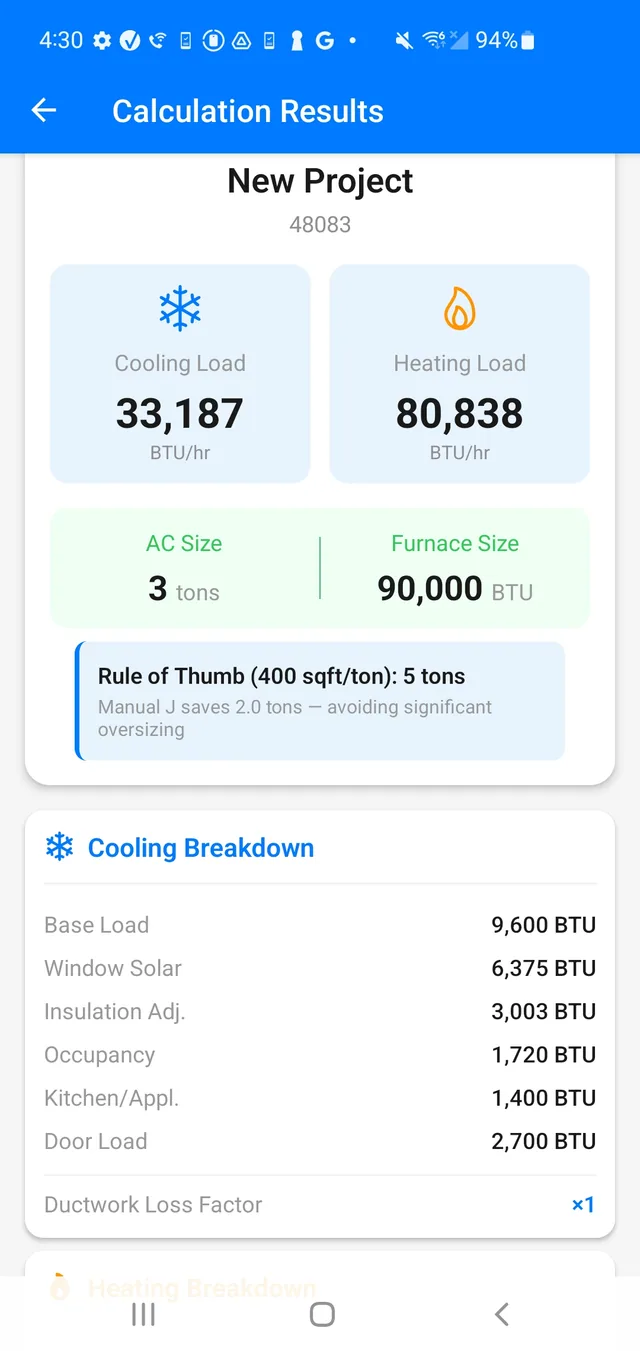
A whole-house Manual J load calculation in your browser: heating BTU, cooling BTU, and nominal tons. No account, no email, no PDF paywall. It resolves your ZIP code to real 99% and 1% design temperatures instead of asking you to guess a climate region, and it runs the same engine as our Manual J load calculator app.
Scope: whole-house block load, Manual J methodology, US ZIP codes only. Eight inputs means the engine assumes typical values for orientation, foundation, occupancy, shading, and infiltration detail. It does not do room-by-room loads, Manual S equipment selection, duct design, or a printable report — those are in the app. Professional estimating aid for qualified technicians — not ACCA approved or certified, and not a stamped design.
Four apps · One toolbag
The calculator above runs the same engine as the HVAC Load Calculator app. The apps add room-by-room loads, equipment sizing, duct checks, and A2L charging, and every one works without a signal.
Run a real Manual J at the kitchen table. Equipment sizing, climate data by ZIP, and a homeowner-ready PDF with your logo on it.

F280-based loads with NRCan design temperatures by postal code. Metric first, English and French, built for Canadian winters.

The ductulator in your pocket — forward and reverse — plus static pressure checks and a full Manual D system designer with PDF export. Free, fully offline.

New: EPA 608 practice for Core, Type I, II and III with a 100-question Universal mock, plus 300+ questions for the A2L / Low GWP safety exam, and superheat, subcooling, and max allowable charge for A2L refrigerants with glide handled right. Free, no account.
What this actually calculates
Most free HVAC load calculators on the web are a multiplication. You give them square footage, they divide by 500 or 600, and they hand back a tonnage. That is the same rule of thumb that has been oversizing residential equipment for forty years — and oversizing is not a harmless error. A cooling system that is a ton too big short-cycles, never runs long enough to pull moisture out of the air, and leaves a house that is cold and clammy instead of comfortable. The homeowner then complains about humidity, and the fix costs more than the right-sized equipment would have.
This tool does something different. It runs a genuine whole-house block load: conduction through walls, ceilings, windows, and doors; solar gain through glazing; infiltration driven by the tightness implied by your insulation level; internal gains from occupants and appliances; and duct losses based on where the ductwork actually runs. Those pieces are summed into a sensible and latent cooling load and a heating load, then rounded to a nominal equipment size the way the standard expects.
Why the ZIP code matters
Load is fundamentally driven by the temperature difference between the inside of the house and the outdoor design condition. Get that difference wrong and every downstream number is wrong by the same proportion, no matter how carefully you entered the rest.
The convention is the 99% winter dry-bulb and the 1% summer dry-bulb: the temperatures your location stays above and below for 99% and 1% of the hours in a year. They are not record highs and lows — sizing to a record cold snap is another route to oversized equipment. Most free calculators skip this entirely and offer a dropdown with four or five climate regions, which can put you 20°F or more away from your actual design condition. Minneapolis and St. Louis are both “cold,” and their heating design temperatures are about 40°F apart.
This calculator looks your ZIP up against a published design-temperature dataset and shows you exactly which location and which temperatures it used, along with how precisely your ZIP resolved — a specific weather station, a mapped reference city, or a regional approximation from the three-digit prefix. If it had to approximate, it says so rather than presenting a regional guess as a station-grade number.
Where it stops
Honesty about scope is the difference between a useful estimating aid and a number that gets someone in trouble. A block load from eight inputs answers the equipment-sizing question well enough to sanity-check a proposal, catch an obviously oversized quote, or get a budget number on the phone. It assumes typical values for a lot of things a full calculation would ask you about: window orientation and shading, foundation type and slab perimeter, occupancy, appliance load, ventilation, and the specific R-values of your assemblies.
What it will not do is tell you how much air each room needs. That is a room-by-room calculation, and it is the input to duct design — a block load cannot substitute for it, no matter how accurate the whole-house total is. It also will not produce Manual S equipment selection guidance, a heat-pump balance point, or a report you can hand to a building department. If you need any of those, the HVAC Load Calculator app does room-by-room loads, equipment sizing, and branded PDF reports, and it works with no signal in a crawlspace. If the job is Canadian, CSA F280-12 is a different rulebook and needs its own tool.
For more on that distinction, read block load vs room-by-room Manual J.
When the estimate has to hold up
Room-by-room loads, Manual S equipment sizing, ZIP climate data, and a homeowner-ready PDF with your logo on it. Works with no signal, because the crawlspace never has any.
Buying equipment?
Once you know your load, the next question is usually where to buy. A local supply house is the right answer for most contractors; a homeowner, or a tech without a distributor relationship, can buy complete central systems online in the same standard sizes. Whatever you buy and wherever you buy it, size the equipment to your calculated load per Manual S — not the other way around. How our affiliate links work.
Complete central systems, heat pumps and ductless mini-splits in standard sizes are sold at HeatAndCool.com (affiliate link — we earn a commission on purchases, and your price is unchanged).
Ductless or window equipment in these sizes is also sold on Amazon (affiliate link — as an Amazon Associate we earn from qualifying purchases).
Going ductless, or running a window or portable unit? Sensibo makes smart controllers that add scheduling, remote control and energy tracking to any remote-controlled AC or heat pump (affiliate link — we earn a commission on purchases, and your price is unchanged).
Prefer to have it installed? Get quotes from local installers (a referral link — we may be paid for the lead, at no cost to you).
Common questions
It runs a genuine block load with real design temperatures, which puts it well ahead of a square-foot rule of thumb. But it is eight inputs. Treat it as a sanity check and a starting point — anything you install equipment against should be a room-by-room calculation with the actual assemblies entered.
Because load is driven by the indoor-to-outdoor temperature difference. Picking from four climate regions can put you 20°F off your real design condition. This tool uses published 99% and 1% design dry-bulb values and shows you which ones it used.
Yes, for the same inputs. The page runs the app’s calculation engine, extracted at build time rather than reimplemented, and an automated test compares the two across dozens of input combinations and climate zones on every build.
A block load treats the house as one zone and answers the equipment-sizing question: how many BTU per hour the whole building needs. Room-by-room answers the distribution question: how much air each room needs, which is what you size ducts from. This calculator does the block load.
The lookup falls back to your three-digit ZIP prefix for regional coverage, and the result tells you that is what happened. If nothing matches at all, it uses a national mid-range default and says so.
No. It is a professional estimating aid based on Manual J methodology — not ACCA approved or certified, and not a substitute for a stamped design where one is required.
No. The calculation runs entirely in your browser. Nothing you type is sent to a server, and nothing is saved between visits.
Why these apps
Free in your browser
Size a duct run, check superheat on an A2L system, or read how the numbers are built. Every tool is free, works in the browser, and states its assumptions. When the signal dies in a crawlspace, the full apps do the same math offline.

