Which refrigerants does this P/T tool support?
R-454B (bubble and dew columns), R-32, and R-410A. Tables are a subset of the same PT data used in the A2L Safe Charge app, with linear interpolation between published points.
Browser micro-tool
Quick R-454B, R-32, and R-410A saturation lookup with superheat and subcooling. R-454B uses dew for superheat and bubble for subcooling — the same glide rule as the offline app.
OEM nameplate and charging chart override these typical bands. Verify gauge calibration and system stability before adjusting charge.
PT tables and glide rules are a subset of the A2L Test Prep app data (NIST REFPROP / National Refrigerants / Hudson Technologies attributions above). Linear interpolation between 5°F table points. This page does not calculate room-based A2L max charge — that lives in the app, structured per UL 60335-2-40 / ASHRAE Standard 15.2.
Reference table
Displayed slice of the embedded table. Calculations use the full −60°F / −40°F to 150°F dataset shipped in the script.
Common questions
R-454B (bubble and dew columns), R-32, and R-410A. Tables are a subset of the same PT data used in the A2L Safe Charge app, with linear interpolation between published points.
Superheat uses dew-point saturation temperature. Subcooling uses bubble-point saturation temperature. R-32 and R-410A use a single saturation column.
No. It is an informational estimating aid for qualified technicians. Typical ranges are context only. The OEM nameplate and charging chart override field bands. Room-based A2L max charge is available in the offline A2L Safe Charge app.
Worked example
The tool opens on a typical reading: R-454B, 107 psig at the suction service port, and 50°F on the suction line. It looks up 107 psig on the dew side of the table and gets a saturation temperature of 40°F. Line temperature minus saturation temperature is 10°F of superheat, which sits inside the 8 to 12°F band the tool shows for context.
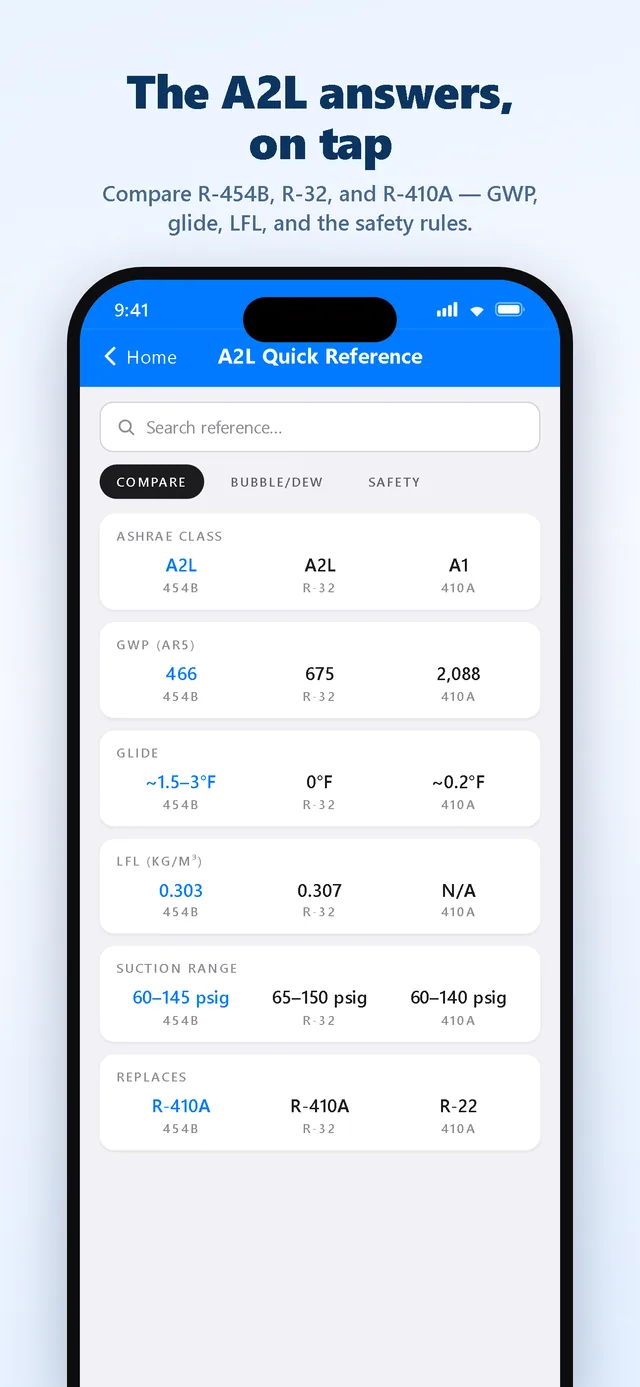
The word “dew” matters. R-454B is a blend, and at one pressure it boils across a range of about 1.5 to 3°F instead of at a single temperature. Superheat is measured from the point where the last liquid has boiled off, so it uses the dew value. Subcooling is measured from the point where the last vapor has condensed, so it uses the bubble value. Read the wrong column and the charge looks a couple of degrees off when it is not. The tool picks the column for you and says which one it used.
Where it stops
The bands shown here are typical values, given for context. The manufacturer’s charging chart and the unit nameplate set the target for the system in front of you. This page also does not work out the maximum allowable charge for a room. For the full method, read the R-454B and R-32 superheat and subcooling guide.
Crawlspace has no signal?
Same PT math on your phone, plus room-based max charge, history, and PDF job tickets — free on the App Store.
Related