HVAC Duct Tools app icon

US · Manual D methods

Ductulator and duct static pressure tools for the field.

Size a run, check total static, catch an undersized duct — or design the whole system and hand over the PDF. The ductulator stays in your pocket when the crawlspace has zero bars.

  • Free field tools
  • iPhone & iPad
  • Works offline
  • Dark mode
  • No sign-in, no tracking

Take the ductulator offline. Static pressure checks and Manual D math never wait on a signal.

In the field

From one duct run to a complete system.

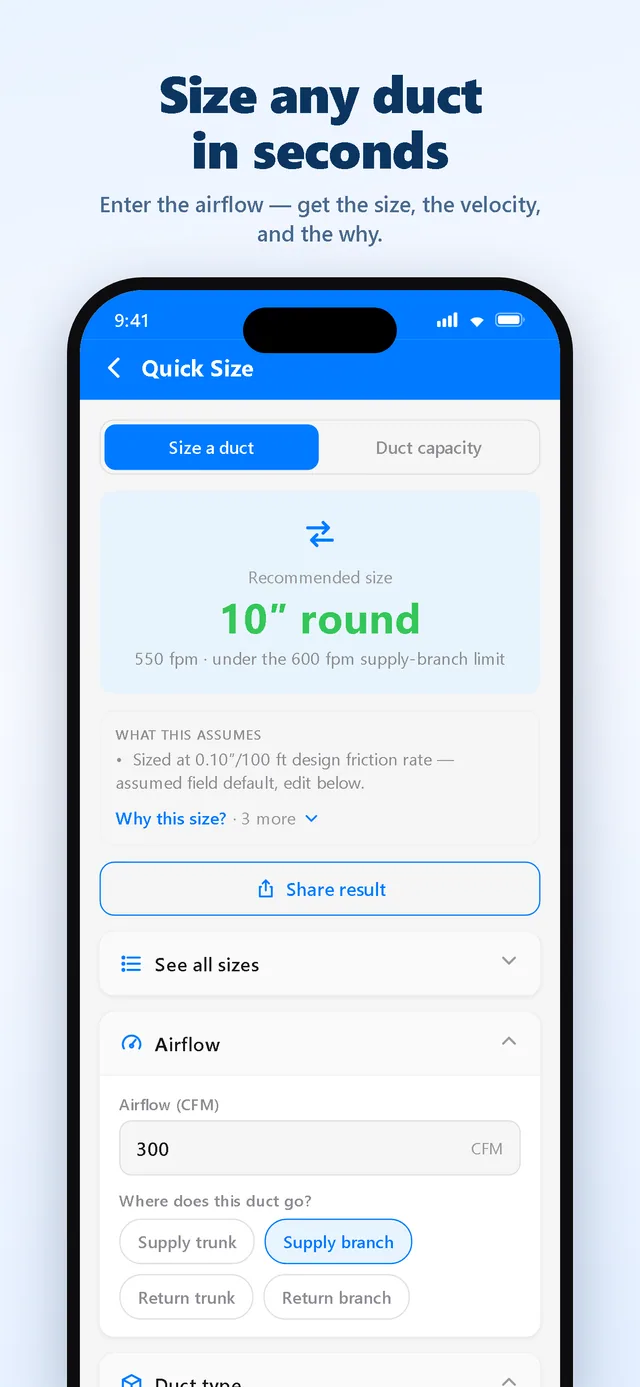
HVAC Duct Tools Quick Size result recommending a 10-inch round supply branch for 300 CFM
Size a run and see which velocity or friction limit governed it.
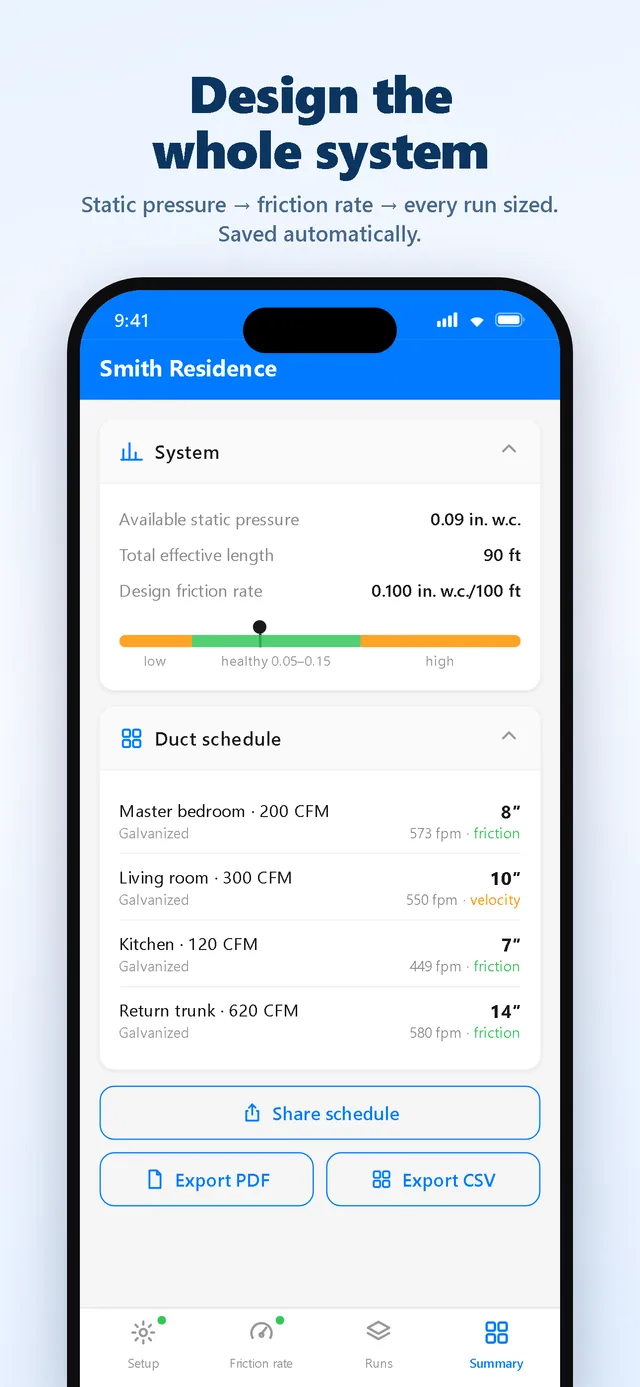
Manual D system design showing available static pressure, friction rate, and a sized duct schedule
Turn the static-pressure budget into a complete duct schedule.
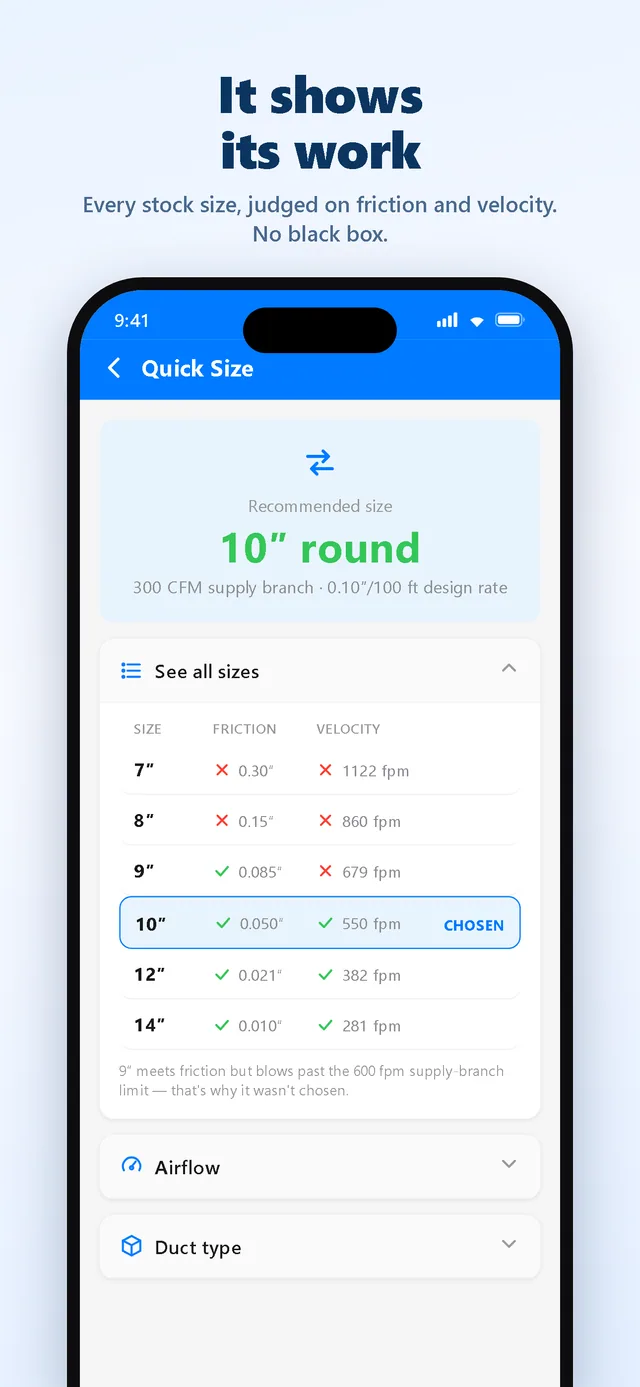
HVAC duct size comparison showing airflow, velocity, and friction results for stocked round sizes
Compare stocked sizes and see why each one passes or fails.

Who it’s for

Built for the call, not the office.

Service and install techs. If you carry a manometer and argue about duct sizes, this ductulator app is yours. No account, no cloud, no signal needed in a crawlspace. Punch in what you can measure and screenshot the verdict.

  • Quick Size. Enter CFM, get the round size. About ten seconds, with velocity and which limit governed the answer — and a “see all sizes” table that judges every stocked size on friction and velocity, so you can see exactly why 9″ lost.
  • Duct capacity, in reverse. Point it at an existing duct and get what it can honestly carry: an ideal CFM plus the full band, min to max. Flex shows both compressed and fully stretched numbers, so the field table and the app stop arguing.
  • Real materials, not chart guesses. Galvanized, duct board, lined, or flex with actual compression. 15 percent field sag is the default, because that is what flex does.
  • Rectangular and flat oval too. Boxed into a joist bay? Fix one side and it solves the other, with the equivalent round shown.
  • Static pressure verdict. Supply plus return against the equipment’s rated max. Total, headroom, and which side is eating your static.
  • Duct Check. Existing size plus airflow tells you if that run was ever big enough. Undersized, oversized, or fine, judged against the Manual D velocity limit for its role.
  • Design a full system. Static-pressure budget to friction rate to a sized duct schedule, run by run. Start at an assumed 0.10 before you have a duct plan — it stays loudly flagged until your real paths derive the real rate. Projects save automatically and survive a force-quit.
  • PDF and CSV export. The duct schedule as a homeowner-ready PDF or a spreadsheet-ready CSV, with every caveat the screen showed. What you hand over says what it assumed.
  • Honest math. Every result states what it assumed, so a defaulted 0.10 friction rate never hides in the fine print. Bad inputs read as “check your inputs,” not a confident wrong answer.
  • No cloud, period. Fully offline, no sign-in, no tracking, no analytics. Nothing is uploaded — your numbers leave the phone only when you choose to share or export them.

The numbers behind the numbers

Equation-derived, stocked-size honest.

  • Method: Manual D friction-rate approach; design friction rate = ASP × 100 ÷ TEL, healthy band 0.05 to 0.15 in. w.c. per 100 ft, default field rate 0.10 and editable.
  • Velocity limits from Manual D targets: 900 fpm supply trunk, 600 supply and return branch, 700 return trunk, 300 at the filter grille.
  • Stocked sizes only: rounds snap to 4 through 16 inch, skipping 11 and 13, because your supply house does too.
  • Engine: Darcy-Weisbach with Altshul-Tsal friction, not a scanned chart. Altitude correction to 6,000 ft.
  • Forward and reverse agree by construction: capacity bands are round-trip validated against the same sizing engine, so the two directions cannot disagree.
  • Flex penalty: sized per diameter from LBNL compression research, capped at 30 percent where flex starts to bulge.
  • Sanity checks: TESP totals over 2.0 inches flag as probable misreads, and a verdict that rests on an assumed 0.50 inch rating says so out loud.

Common questions

Ductulator and static pressure FAQ

What is a ductulator and how does this app replace one?

A ductulator sizes duct diameter from airflow, friction rate, and velocity limits. HVAC Duct Tools is a ductulator app that also runs reverse capacity, rectangular and flat-oval sizing, and full Manual D schedules — all offline on your phone.

How do you size an HVAC duct from CFM?

Duct size depends on airflow, material, friction rate, and the velocity limit for the duct’s role. HVAC Duct Tools checks those constraints together and returns a stocked round, rectangular, or flat-oval size.

What is duct static pressure / available static pressure?

Available static pressure is the equipment’s rated external static pressure minus pressure losses from components such as filters, coils, grilles, and accessories. Manual D uses it with total effective length to derive design friction rate. The app also compares supply plus return readings against the rated max for a field static-pressure verdict.

Can the app check an existing duct?

Yes. Enter the installed size, material, and airflow to estimate its capacity and compare velocity and friction against the selected duct role.

Does the ductulator work offline?

Yes. Every tool runs on the device with no account, no cloud, and no signal required in a crawlspace.

Is this ACCA approved Manual D software?

No. It is a professional field estimator based on ACCA Manual D methods. It is not ACCA approved or certified, and it is not a substitute for a stamped Manual D design or measured commissioning.


Get it offline

Free. The ductulator stays in the truck.

HVAC Duct Tools is on the App Store now — free, no account, no ads. Quick tools for the call you’re on, a full system designer for the quote you’re writing. Works when cellular does not.