
Is this a full Manual D ductulator?
No. It is a simplified browser subset for quick galvanized sizing and checks. ASP/TEL, fittings, flex, and full schedules are in the Duct Tools app.
Browser micro-tool
Size a galvanized run from CFM, design friction rate, and role velocity — or reverse-check an existing size. Simplified, attributed math from our duct-engine. For the crawlspace with no signal, take Static Pressure & Duct Check offline.
Scope: galvanized ε = 0.0003 ft, sea-level standard air, Darcy–Weisbach + Altshul–Tsal, Huebscher for rect. Stocked rounds: 4–10, 12, 14, 16. No flex PDCF, altitude, fittings/TEL, flat-oval, or ASP→FR. Math attributed to the Static Pressure & Duct Check duct-engine. Estimating aid for qualified techs — not ACCA approved/certified.
Worked example
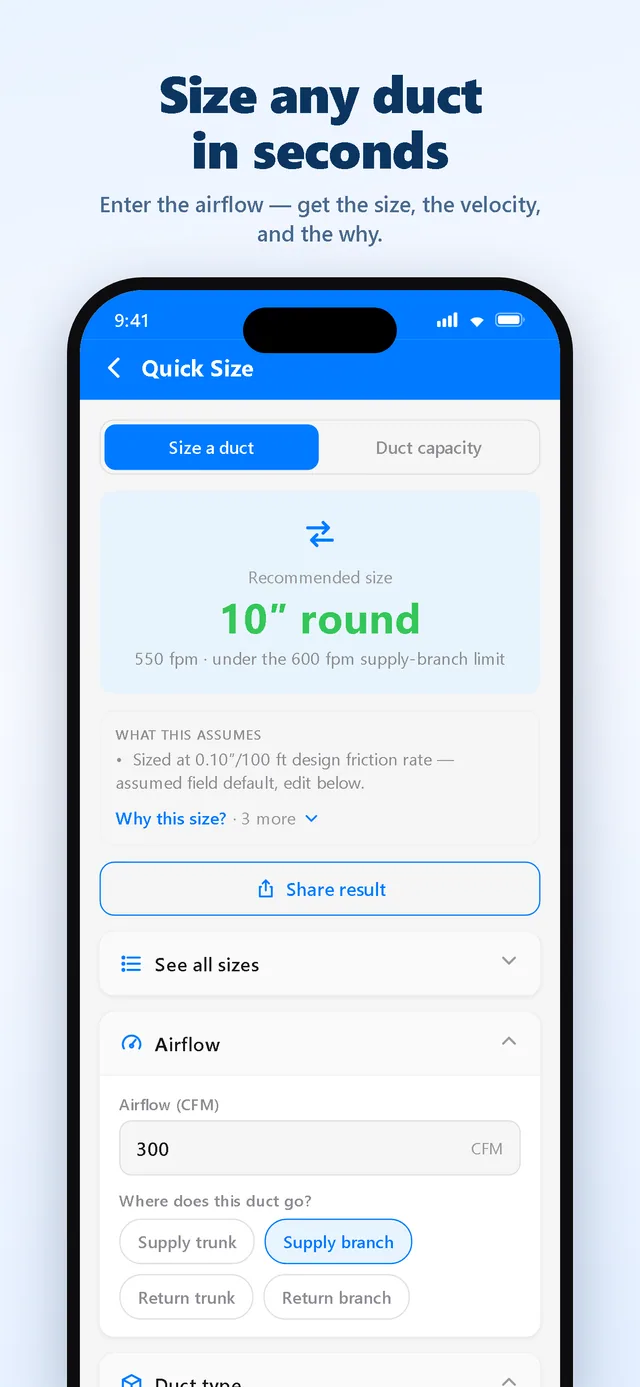
The tool opens on a common case: a 300 CFM supply branch in round galvanized duct at a design friction rate of 0.10 in. w.c. per 100 ft. Friction alone would pick a 9 in. round, which runs at 0.085 in. w.c. per 100 ft. But 300 CFM through a 9 in. duct moves at 679 fpm, and the limit this tool uses for a supply branch is 600 fpm. So the recommendation steps up to a 10 in. round: 550 fpm at 0.051 in. w.c. per 100 ft. The result says “velocity governs” so you know which limit set the size.
That is the part a paper ductulator leaves to you. The wheel gives you the friction answer, and the velocity check is a second look you have to remember to take. Here both checks run together, and the table under the result shows every stocked size from 4 in. to 16 in. with its friction and velocity, so you can see how close the next size down was.
Checking what is already there
The Check tab runs the question the other way. Put the same 300 CFM through an existing 8 in. round and the tool reports 859 fpm at 0.152 in. w.c. per 100 ft: over the velocity limit and above the usual friction band. That is a duct that will be loud and will cost static pressure the blower may not have. For how those numbers tie back to the blower, read duct static pressure and friction rate.
Round to rectangular
When a round duct will not fit the joist bay, the Convert tab finds the rectangular size that carries the same airflow at the same friction. A 10 in. round with one side held at 8 in. comes out as 10 in. by 8 in., with an equivalent diameter of 9.76 in. The match is on friction at equal airflow, which is why the rectangular duct has more cross-section than the round one it replaces.
Crawlspace has no Wi‑Fi
Static Pressure & Duct Check adds flex materials, static-pressure verdicts, capacity reverse-lookups, and Manual D system schedules — free on iPhone and iPad, no account.
Common questions
No. It is a simplified browser subset for quick galvanized sizing and checks. ASP/TEL, fittings, flex, and full schedules are in the Duct Tools app.
The same Darcy–Weisbach + Altshul–Tsal friction primitive and Huebscher equivalence as our duct-engine, locked to sea-level galvanized air. Read the friction-rate guide: static pressure & friction rate.
No. Professional estimating aid based on Manual D methods — not ACCA approved or certified, and not a stamped design.
Related