Why a Canadian tool
Manual J will give you a number. It will not give you an F280 number.
Most free load calculators on the web are American, and most of them are a multiplication: floor area divided by some constant, out comes a tonnage. Even the honest ones are built on ACCA Manual J and ask for a US ZIP code. Run a house in Thunder Bay through one of those and you will get a result, but it is not the calculation a Canadian job is supposed to be based on.
CSA F280-12 is the same physics under a different rulebook. It is SI-native throughout — square metres, RSI, kilowatts, degrees Celsius — and it differs from Manual J in several places that matter a lot in Canadian housing. It uses its own indoor design setpoints. Its infiltration method is driven by heating degree-days rather than a generic air-change assumption. It models below-grade heat loss against deep-earth temperature, which is a large fraction of the load in a country where most houses have a full basement. And it accounts for CSA F326 continuous ventilation with HRV or ERV heat recovery, which a US standard has no reason to assume is present.
Any of those can move a heating load by double-digit percentages. That is the difference between right-sizing a heat pump and leaving a homeowner with supplementary electric resistance running all February.
The long version, side by side: CSA F280-12 vs Manual J.
Why the postal code matters
Design temperature is the input everyone fudges.
Load is fundamentally driven by the temperature difference between the inside of the house and the outdoor design condition. Get that difference wrong and every downstream number is wrong by the same proportion, no matter how carefully you entered the rest.
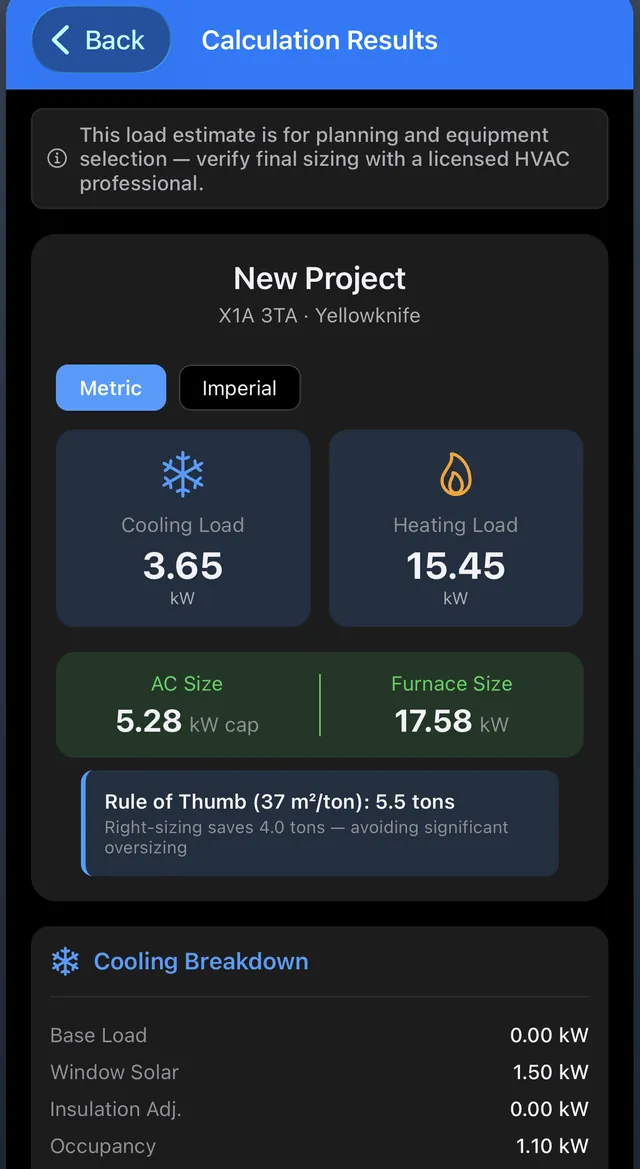
Canada makes this unusually unforgiving. The heating design temperature in Victoria is around −4°C. In Yellowknife it is below −39°C. That is a spread of about 35 degrees, and it is the single largest term in the calculation. A calculator that asks you to choose between “cold” and “very cold” is throwing away the input that matters most.
This tool takes the first three characters of your postal code — the forward sortation area — and resolves them against a climate database generated from NRCan HOT2000 weather-station data. It then shows you the station it used, the heating and cooling design dry-bulbs, and the heating degree-days that fed the infiltration model. It also tells you how precisely your FSA matched: to its own station, to a regional bucket, or to a provincial baseline. If it had to approximate, it says so rather than presenting a fallback as a station-grade number.
Where it stops
What eight inputs can and cannot tell you.
Honesty about scope is the difference between a useful estimating aid and a number that gets someone in trouble. A block load from eight inputs is enough to sanity-check a proposal, catch an obviously oversized quote, or get a budget number while you are standing in a driveway. It assumes typical values for a lot of things a full F280 calculation would ask you about: window orientation and shading, measured airtightness, ventilation rate and recovery efficiency, occupancy, foundation depth and insulation, and the actual RSI of each assembly.
There is a second limit, and it is specific to this tool rather than to block loads in general. The F280 coefficients behind the calculation are still being verified against the published standard, so every result is stamped provisional. That is deliberate and it is disclosed on every calculation. It means this is a sizing sanity check, not compliance documentation — do not attach it to a permit application or a rebate submission.
What it will not do is tell you how much air each room needs. That is a room-by-room calculation, and it is the input to duct design. It also will not take a blower-door ACH50 result, let you override window U-factor and SHGC from an NFRC label, model HRV recovery efficiency, or produce a report with your logo on it. If you need those, the HVAC Load Calculator CSA F280 app does all four, works offline in a basement with no signal, and is free.